
Light, texture & everyday practicality
Shutters With Curtains: Ideas and Practical Advice
Yes, you can have curtains with shutters. Shutters let you adjust daylight and sightlines; curtains add fabric, colour and another layer you can close in the evening.
The most useful pairing starts with a simple question: will the curtains close, or just frame the window? That answer affects the fabric, track position, opening space and even where your furniture belongs.
By London Shutter Specialists · Published 6 November 2026
Explore the pairing ideas
The room images in this guide are illustrative design inspiration. Use them to compare layouts and finishes; the final fitting needs to suit your own windows.
Do you need curtains with shutters?
No. Full-height shutters can dress a window on their own. Add curtains when they solve a particular need: a softer finish, an evening covering above café shutters, or extra room darkening. Decorative side panels give you the look of curtains but do not provide the coverage of a pair that closes.
Curtains or no curtains with plantation shutters?
| Your priority | A useful starting point | Check before choosing |
|---|---|---|
| Keep the window simple | Shutters without curtains | Whether the chosen coverage gives you the privacy you need. |
| Add colour and softness | Shutters with decorative side panels | The fabric stack and shutter opening space. |
| Cover clear glass above café shutters at night | Curtains that close across the whole window | Opacity, centre overlap and views from outside. |
| Make a bedroom darker | Shutters with closing, opaque lined curtains | Top and side gaps; compare an integrated blackout blind too. |
| Keep a busy window seat usable | Shutters alone or a carefully planned blind | Cushions, drawer access, catches and moving panels. |
Shutters with curtains ideas: five looks to compare
If you are looking for pictures of curtains with plantation shutters, compare more than the colours. Look at where the fabric gathers, which glass is covered and what sits in front of the panels.
Idea 01
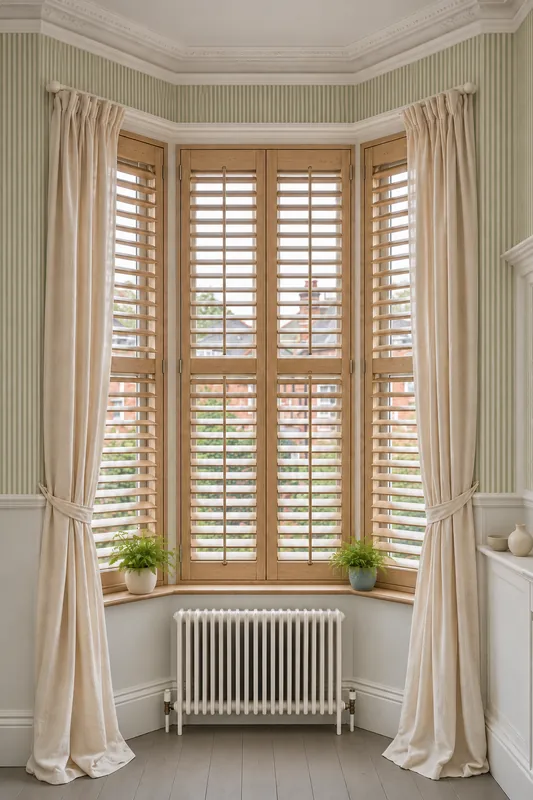
Natural wood shutters with soft cream curtains
Warm timber and cream fabric share a gentle palette while keeping their textures distinct. In this bay, the curtains frame the outer sides and leave the central radiator visible when open.
- Compare a fabric sample beside the actual shutter finish in daylight and under your evening lighting.
- Keep gathered fabric clear of the side panels and their opening path.
- If the curtains will close, check their position relative to the radiator—not just the open arrangement shown here.
Idea 02
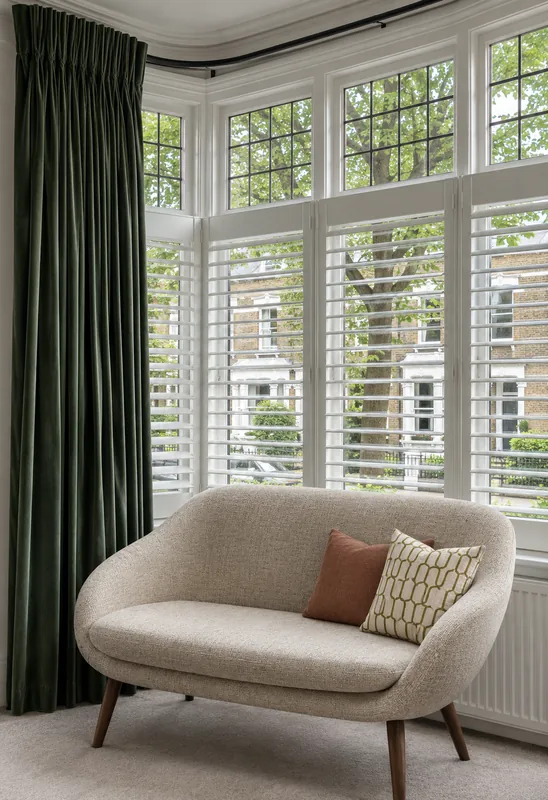
Deep green curtains with white café shutters
A deep green fabric gives white shutters a stronger outline. The café height keeps the upper glazing visible; the darker curtain stack makes a deliberate feature of the side of the bay.
Heavier lined fabric can gather into a substantial stack. Ask to see its expected width and depth, rather than judging the space from an unlined sample. Leave enough room to move the loveseat when opening the lower panels for cleaning.
See café shutters for bay windows for coverage choices.
Idea 03
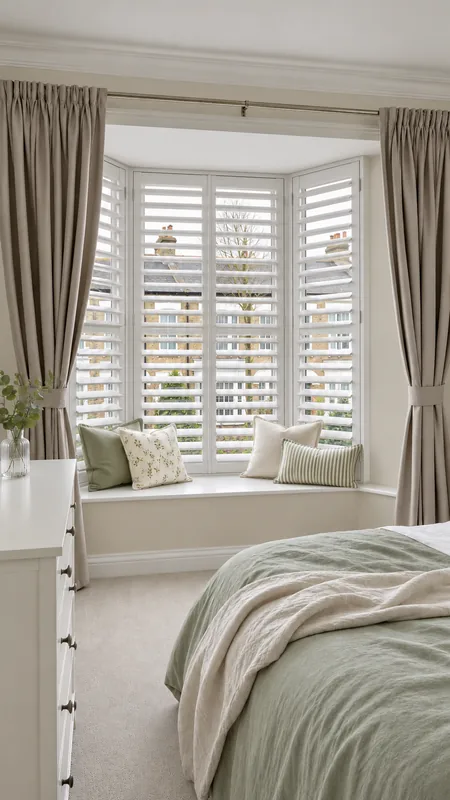
Curtains with plantation shutters in a calm bedroom
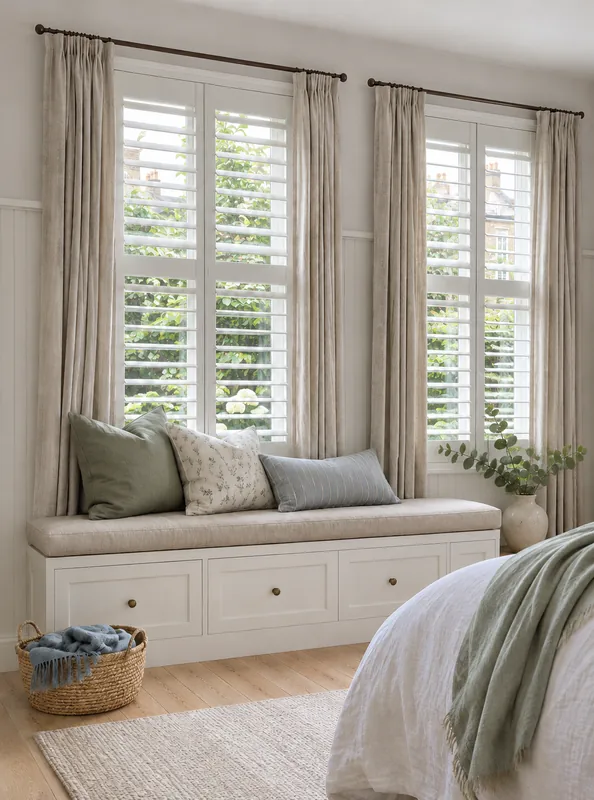
Soft taupe curtains and white full-height shutters keep the main window neutral, leaving bedding and cushions to carry the colour. A pole across the front frames the bay as one opening.
Decide whether closing the curtains across the bay entrance is useful: it puts the seat behind the fabric at night. If you want to use the seat with the curtains closed, a track following the bay may be worth discussing instead.
For sleep, choose the lining and edge details separately from the decorative face fabric. Compare the blackout shutters and blinds options.
Idea 04
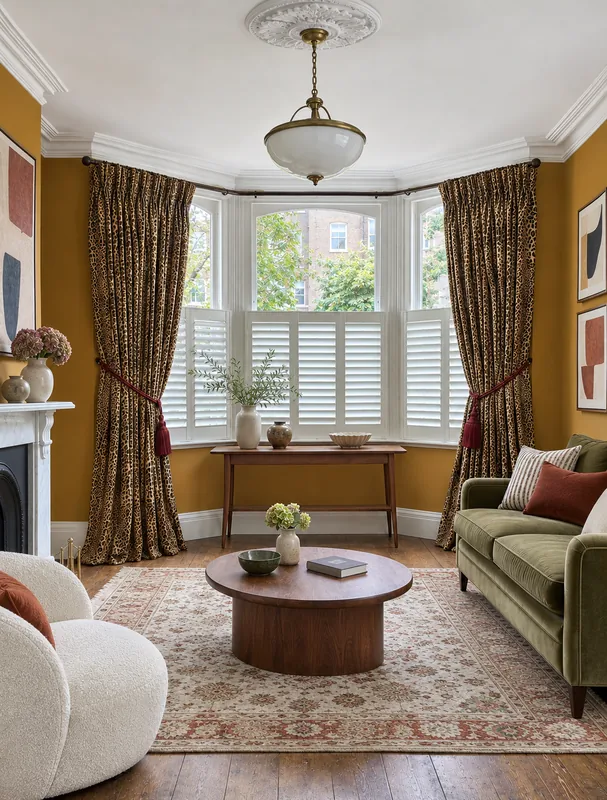
Patterned curtains with simple white shutters
A plain shutter finish lets patterned curtains become the focal point. Here the mustard walls, brown pattern and olive furniture share warm tones without matching exactly.
Check a large piece of fabric with several folds: a tiny swatch does not show how a repeat looks when gathered. Tiebacks can shape the open curtains, but their position must leave the hinged panels and handles usable.
The console in front of this illustrative bay is another reminder to plan access. Tilting louvres is not the same as being able to swing a whole panel open.
Idea 05
Shutters and curtains together above a window seat
Separate curtain pairs can define two windows while the seat joins them visually. A restrained fabric keeps the narrow space between the windows from feeling crowded.
- Check whether the middle stacks cover useful glass or catch adjacent shutter panels.
- Keep fabric out of drawer runners and away from handles.
- For a working seat, consider a hem that clears the cushion rather than fabric that pools on it.
How to pair plantation shutters with curtains: check the moving space
A curtain pole above the frame does not automatically give the shutters room to open. Check three different spaces before ordering:
01
The blade space
Tilt the louvres through their intended range. Check projecting window handles and any fabric that hangs close to the frame.
02
The panel space
Trace the whole door swing or folding path with the curtains gathered. Include tiebacks, finials, brackets and furniture.
03
The fabric space
Allow for the depth as well as the width of the curtain stack. A thicker lining or different heading changes how it sits.
A simple curtain-stack example
Imagine a straight opening with 240mm of usable wall beside each jamb. Your curtain maker estimates that each open curtain will occupy 320mm along the track. If both stacks sit against those outer limits, each extends 80mm into the opening: 160mm of the opening is covered in total.
That is a reason to review the heading, fabric bulk, available track extension or whether curtains are useful here. It is not a rule for sizing a pole. These are hypothetical planning figures; use your curtain maker’s actual stack dimensions and check the shutter swing separately.
Where possible, agree the shutter frame and opening layout before final curtain measurements. If you are keeping existing curtains, bring their fixing position into the shutter survey from the start. There is no universal bracket projection that clears every shutter and heading.
Curtains with shutters in a bay: choose where the curtains close
Across the front of the bay
A straight pole or track spans the room-side opening. It frames the whole bay and can keep the side windows clear when the curtains stack outside it.
- Closing the curtains screens off the seat or furniture within the bay.
- Check where the fabric hangs relative to a radiator.
- Side walls may limit how far the pole extends.
Following the shape of the bay
An angled or curved track follows the windows. The bay can remain part of the room when the curtains are closed, depending on the track position.
- Corner brackets and fabric folds need to clear side shutter panels.
- Check how the curtains travel around each bend.
- Confirm the track’s final geometry after the shutter frame position is agreed.
For either layout, ask for a view of the whole bay with the curtains both open and closed. Then check one window-opening sequence: park the fabric, open the shutter, reach the catch, operate the window and close everything again. See our bay-window shutters guide for the shutter layout itself.
What do shutters and curtains add to light control, warmth and privacy?
A darker bedroom
Opaque lined curtains can reduce light that passes around standard shutters. The result depends on coverage at the top, sides and centre. Decorative side panels cannot do that job, and standard shutters still have small light gaps.
An extra evening layer
Well-fitted curtains can help reduce heat loss when closed. Fabric, lining, fit and the window all matter; adding a second layer does not give a fixed energy saving. Keep radiators and their controls clear, including when the curtains are closed.
Privacy after dark
Café shutters leave upper glass uncovered. Closing opaque curtains can cover that view. Sheers diffuse daylight, but their screening changes with the lighting: check from outside with the room lights on rather than relying on a daytime photograph.
For general heating guidance, the Energy Saving Trust’s Warm Home Hacks guide (PDF, opens in a new tab) recommends closing thick or thermally lined curtains at night while keeping radiators unobstructed.
Other window treatments for plantation shutters
A Roman blind above café shutters
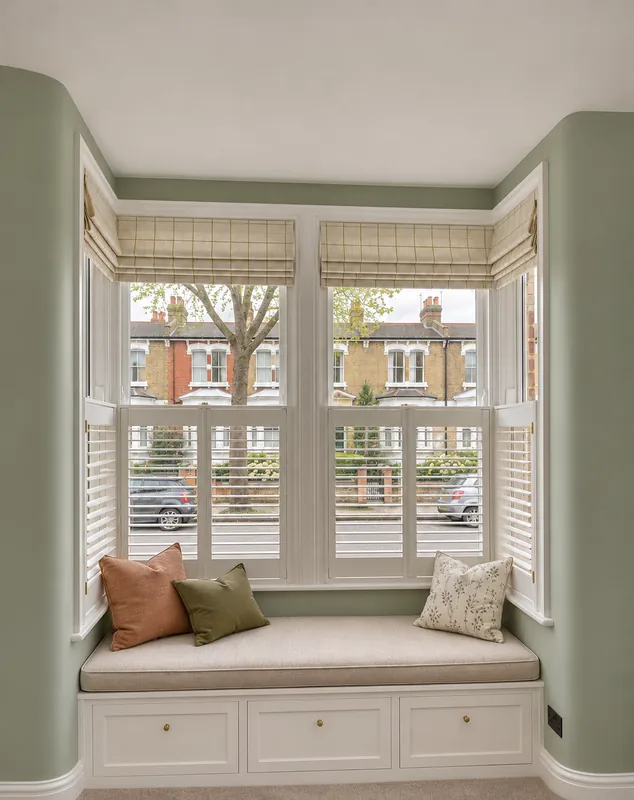
This window-seat illustration uses Roman blinds, rather than curtains, above café shutters. It is worth comparing when you want fabric colour without floor-length side stacks.
Check how much upper glass the raised blind covers, and whether its lowered position or controls interfere with the shutters. Confirm headrail depth, fixing space and access to window catches. Fabric near a seat also needs to stay clear of cushions and moving panels.
Or leave the shutters on their own
If full-height shutters already give you the finish and privacy you want, there is no need to add fabric. For extra darkness with less fabric at the sides, ask about a compatible blind-and-shutter arrangement. Compare shutters and blinds before deciding which layer earns its space.
Before you order curtains with shutters
Your window planning check
Will both layers work every day?
Tick the points you have checked. Use the remaining points as questions for your shutter survey and curtain maker.
0 of 6 checked. Check the remaining points before ordering either layer.
This checklist stays on this page and resets when you reload.
For the survey, take one photograph of the whole window wall and another showing the reveal, handles and existing curtain fixings. Note whether you want to keep the current curtains, use the window seat at night, or open the panels every day. These details are more useful than a room photograph alone.
Your questions about shutters and curtains
Can you still have curtains with shutters?
Yes. Curtains can sit in front of shutters, provided their heading, brackets and gathered fabric leave room for the panels to open. Existing shutters can stay; assess their opening movement before choosing a new pole or track.
Can I put curtains on windows with shutters?
Yes. Plan both layers together: the shutters at the window, and the curtain fixing and fabric in a position that clears them. Check the supporting wall or ceiling, as well as the space available beside the opening.
Do shutters look better with or without curtains?
With curtains, the window gains fabric texture and a stronger frame. Without them, the shutters and surrounding joinery remain more exposed. Choose around the room’s proportions and the job you need the curtains to do, rather than assuming one look is always better.
Do you have curtains with shutters in a small room?
You can, but check how much wall and glass the open curtains will cover. A lighter fabric or less bulky heading may suit the space. If the stacks crowd the window or obstruct the shutters, leaving the shutters on their own can be the more useful choice.
Should curtains go in front of or behind shutters?
For the layered arrangements shown here, curtains sit on the room side of the shutters. The fixing position depends on the recess, frame, heading and panel movement. A pole mounted above the window can still be too close if the fabric catches an opening panel.
Can I keep my existing curtains when shutters are fitted?
Often, yes. Ask the surveyor to check the existing track or pole with the curtains both open and closed. A different bracket projection, track position or shutter layout may be needed. Check this before ordering rather than assuming the current position will work.
Will curtains with plantation shutters make the room blackout?
They can make it darker, especially with opaque lined curtains, but light can still enter at the top, sides or centre. A blackout fabric does not guarantee a blackout installation. Discuss overlaps and returns, or compare a compatible blind behind the shutters.
Can café shutters and curtains give privacy at night?
Closing suitable opaque curtains across the whole window can screen the clear glass above café shutters. When those curtains are open, the upper glass remains uncovered. Check overlooking views with the room lights on; sheer fabric is not a dependable night-time privacy screen.
Plan the shutters around your room
Bring your curtain ideas to your shutter survey
Tell us which curtains or tracks you want to keep and how you use the window. We can assess the shutter layout, frame position and opening clearance as part of your free home survey.
Coordinate final curtain measurements, heading and track details with your curtain maker. For shutter budgets, see our window shutter prices guide.
Serving homes across London. All room scenes on this page are illustrative inspiration.